
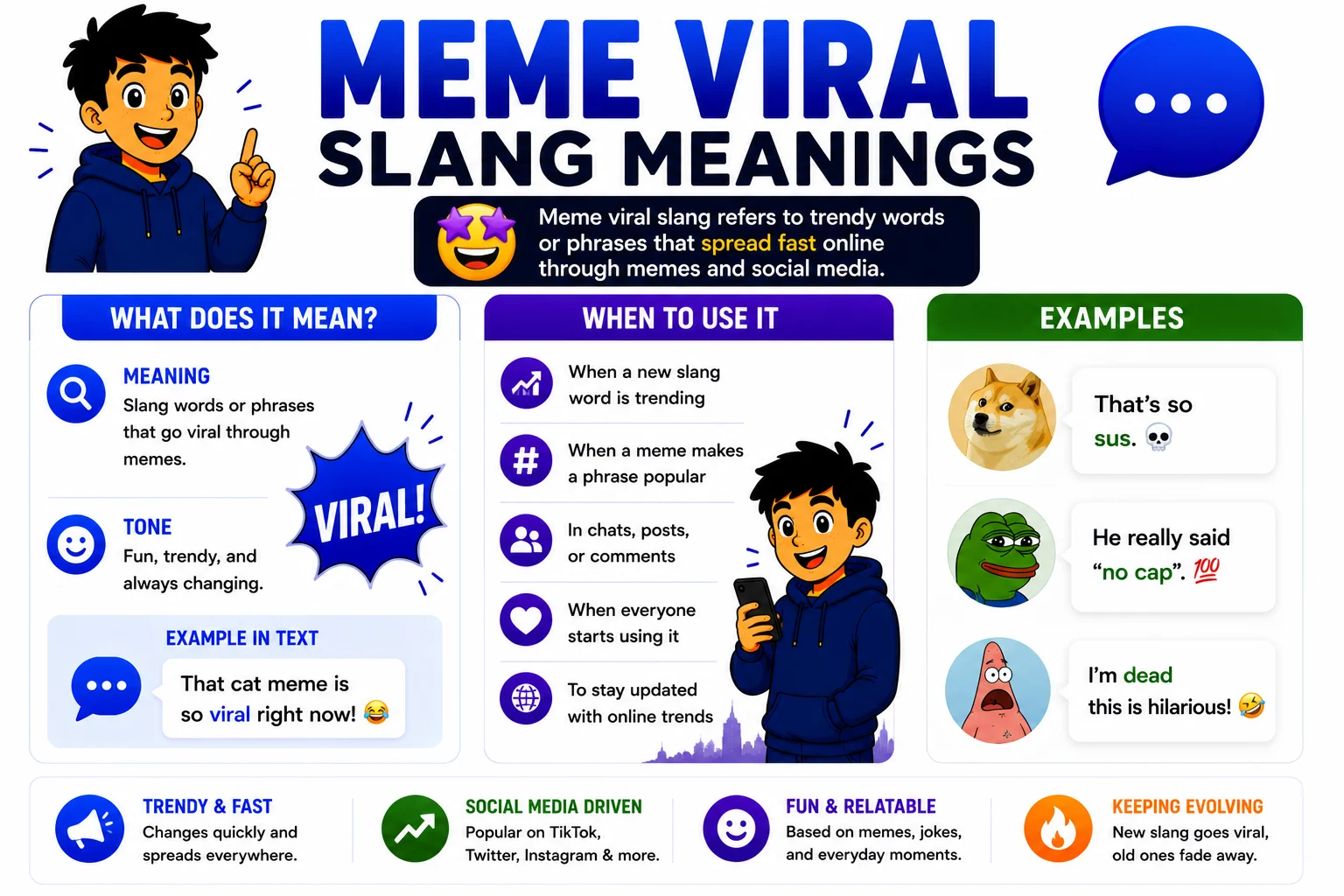
If you spend time on TikTok, Instagram, YouTube, Discord, Twitch, or X, you’ve probably seen words that seem to make absolutely no sense at first: rizz, aura, cooked, sigma, skibidi, brainrot, NPC, 6-7, crash out, glazing, mid, and fanum tax.
These expressions often spread through memes, short-form videos, gaming communities, and comment sections. Some have a clear definition, while others are intentionally absurd. Current slang is also extremely fast-moving, so a word’s meaning can change as different online communities adopt it.
This guide explains some of the most recognizable viral meme slang meanings in simple English.
What Is Meme Slang?
Meme slang is informal language that develops or becomes popular through internet memes, viral videos, social media, gaming, and online communities.
Unlike traditional slang, meme slang can spread incredibly quickly. A phrase might become popular because of one video, creator, song, joke, or recurring meme format.
Some expressions are used seriously, while others are deliberately nonsensical.
For example:
“Bro is cooked 💀”
usually means the person is in trouble, exhausted, defeated, or in a bad situation.
Meanwhile:
“6-7”
may simply be a deliberately nonsensical meme response rather than a phrase with a precise dictionary definition. Current slang references describe 6-7 as a mostly nonsensical viral expression.
Popular Meme & Viral Slang Meanings
1. Rizz
Rizz means charisma or the ability to attract or charm someone, particularly romantically.
Example:
“He’s got serious rizz.”
Meaning: He’s very charming or good at flirting.
Rizz became one of the most recognizable modern internet slang terms and is commonly associated with flirting and charisma.
2. Aura
Aura refers to someone’s vibe, presence, confidence, or perceived coolness.
Example:
“She has so much aura.”
Meaning: She has an impressive presence or confident vibe.
People also talk about gaining aura or losing aura depending on whether someone does something impressive or embarrassing.
3. Aura Farming
Aura farming means deliberately doing things that make you appear cool, confident, mysterious, or impressive.
Example:
“Bro has been aura farming all day.”
It can be sincere or sarcastic.
4. Cooked
Cooked means someone is in trouble, exhausted, defeated, finished, or unlikely to succeed.
Examples:
“I’m cooked for tomorrow’s exam.”
→ I’m completely unprepared.
“Bro is cooked.”
→ He’s in serious trouble.
The exact meaning depends on context.
5. Let Him Cook / Let Her Cook
“Let him cook” means let someone continue because they may have a good idea or plan.
Example:
“Wait, let him cook.”
It can also be used ironically when someone is clearly making a terrible argument.
6. Brainrot
Brainrot refers to absurd, repetitive, extremely online content or language, as well as the feeling of consuming too much of it.
Example:
“I’ve been watching TikTok for three hours. I have brainrot.”
The term became strongly associated with 2020s internet culture and meme language.
7. Skibidi
Skibidi is a largely nonsensical meme expression associated with the Skibidi Toilet viral video series.
It doesn’t have one fixed meaning.
Depending on context, people may use it simply to sound absurd, funny, or intentionally “brainrot.”
8. Sigma
Sigma is an internet meme term portraying someone as independent, confident, self-reliant, or unconcerned with social approval.
Example:
“Bro thinks he’s sigma.”
This is often sarcastic.
The term became heavily associated with memes about exaggerated “lone wolf” personalities.
9. NPC
NPC stands for Non-Player Character.
In slang, calling someone an NPC suggests they are acting:
- Predictably
- Repetitively
- Robotically
- Like they’re following a script
Example:
“Bro is acting like an NPC.”
This can be playful or insulting depending on context.
10. Bot
Bot literally refers to automated software.
As slang, however, bot can describe a person who seems robotic, repetitive, fake, or unable to respond naturally.
Example:
“I’m talking to a bot at this point.”
Meaning:
“This person keeps giving repetitive responses.”
11. Mid
Mid means average, mediocre, or disappointing.
Example:
“That movie was mid.”
Meaning: The movie wasn’t terrible, but it wasn’t impressive either.
It’s often used to criticize something that has received a lot of hype.
12. Glazing
Glazing means praising, complimenting, defending, or supporting someone excessively.
Example:
“Bro is glazing that celebrity.”
Meaning:
“He’s praising that person way too much.”
It is usually used humorously or critically.
13. Crash Out
To crash out means to lose control emotionally and behave recklessly, aggressively, or impulsively.
Example:
“He crashed out over a tiny argument.”
It can describe someone dramatically losing their temper or making an impulsive decision.
14. Fanum Tax
Fanum tax is a meme expression referring to taking some of another person’s food, usually jokingly.
The phrase is associated with streamer Fanum and became part of wider internet meme culture.
Example:
“You got fries? Fanum tax.”
Meaning:
“I’m taking some of your fries.”
15. Gyatt / Gyat
Gyatt is an internet slang expression generally used as a reaction to someone’s large or attractive butt.
It can be used jokingly, but it can also be objectifying or inappropriate depending on the situation.
16. Delulu
Delulu is a playful shortening of “delusional.”
It often describes someone who has unrealistic expectations, especially about relationships or celebrities.
Example:
“I’m delulu if I think my celebrity crush will notice me.”
It is generally used humorously.
17. Sus
Sus is short for suspicious.
It became especially popular through Among Us.
Example:
“Why is he acting so sus?”
Meaning: Why is he acting suspiciously?
18. W
W means win or something positive.
Example:
“You passed the exam? W!”
It can also appear as:
- Big W
- Common W
- Huge W
- Rare W
19. L
L is the opposite of W.
It means loss, failure, embarrassment, or something negative.
Example:
“Missing the deadline was an L.”
20. 6-7
6-7 or 67 became a viral meme expression that is often used as intentionally meaningless or nonsensical internet humor.
The joke is frequently less about a literal definition and more about recognizing the meme itself.
Example:
“How was the game?”
“6-7.”
In many contexts, there isn’t a serious answer being communicated.
Quick Meme Slang Dictionary
| Slang | Simple Meaning |
|---|---|
| Rizz | Charm or flirting ability |
| Aura | Vibe, presence, coolness |
| Aura farming | Trying to look cool |
| Cooked | In trouble, finished, exhausted |
| Let him cook | Let someone continue with their idea |
| Brainrot | Absurd or overly repetitive internet content |
| Skibidi | Nonsense meme expression |
| Sigma | Independent/cool lone-wolf meme |
| NPC | Predictable or scripted person |
| Bot | Robotic or repetitive person |
| Mid | Average or disappointing |
| Glazing | Excessive praise |
| Crash out | Lose emotional control |
| Fanum tax | Taking someone’s food as a joke |
| Gyatt | Reaction to an attractive/larger butt |
| Delulu | Delusional, usually jokingly |
| Sus | Suspicious |
| W | Win |
| L | Loss |
| 6-7 | Viral nonsense meme expression |
Why Does Meme Slang Change So Quickly?
Internet slang evolves rapidly because social media allows millions of people to participate in the same jokes almost instantly.
A phrase can start in:
- A TikTok video
- A Twitch stream
- A YouTube channel
- A gaming community
- A meme page
- A song
- A Reddit thread
and then spread to completely different communities.
Researchers have also noted that internet slang and meme language change rapidly, creating challenges even for language-processing systems trying to understand current meanings.
That’s why today’s viral slang may sound outdated surprisingly quickly.
Meme Slang vs. Traditional Slang
There is a small difference between the two.
Traditional slang often develops naturally within particular communities and can remain popular for years.
Meme slang is frequently connected to a specific viral joke, video, creator, or trend.
For example:
“Rizz” has developed into a recognizable slang word with a relatively stable meaning.
But a deliberately absurd meme phrase may become popular without having any consistent literal definition.
How to Use Viral Slang Naturally
The easiest way to use meme slang correctly is to understand the tone rather than memorizing definitions.
For example:
“Bro is cooked 💀”
sounds casual and humorous.
But saying:
“My coworker is an NPC.”
in a professional setting would sound inappropriate.
Keep in mind that slang can also vary by age group, platform, and community. A term that is common on TikTok may sound strange in a workplace or formal conversation.
FAQs
What is viral meme slang?
Viral meme slang consists of words and phrases that spread rapidly through memes, TikTok, gaming, social media, and online communities.
What are the most popular meme slang words?
Some widely recognized examples include rizz, aura, cooked, sigma, NPC, brainrot, skibidi, mid, glazing, W, L, and 6-7. Current slang references continue to track these terms as their usage changes.
What does brainrot mean?
Brainrot describes absurd, repetitive, highly online content or the effect of consuming too much of it.
What does “bro is cooked” mean?
It usually means “bro is in trouble,” “bro is finished,” or “bro is unlikely to succeed.”
What does aura mean in slang?
Aura means someone’s vibe, presence, confidence, or perceived coolness.
What does 6-7 mean?
In current viral meme usage, 6-7 is often intentionally nonsensical. The humor comes from recognizing and repeating the meme rather than from a precise literal meaning.
Final Thoughts
Meme and viral slang can seem confusing because the meanings aren’t always literal. Words such as rizz, aura, cooked, NPC, sigma, brainrot, skibidi, and 6-7 often depend heavily on the joke, platform, and context in which they’re used.
The best way to understand viral slang is to look at how people use the word in actual conversations, rather than relying on a single fixed definition. Internet language changes quickly, so some expressions will eventually disappear while others become part of everyday vocabulary.