
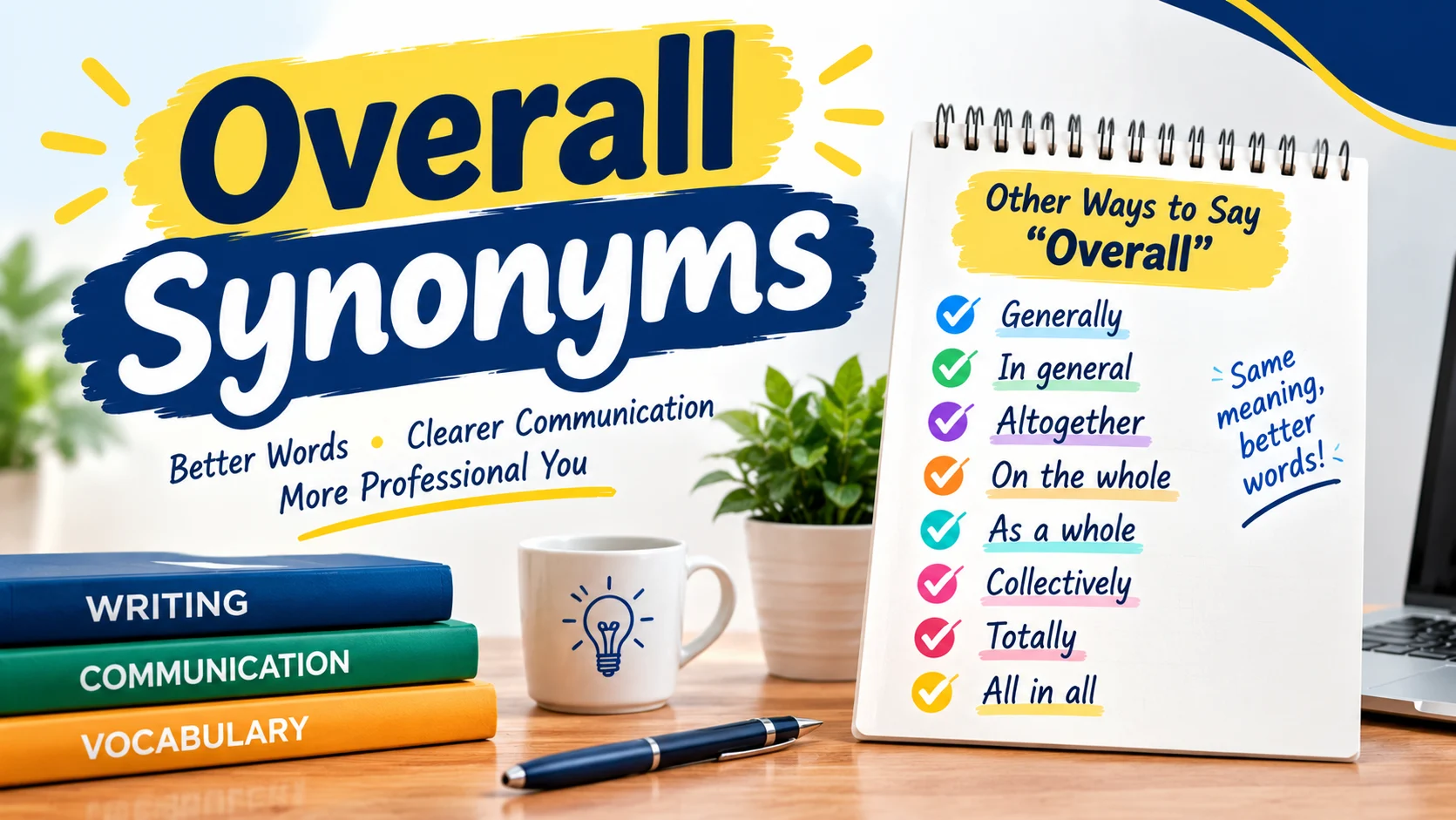
The word overall is useful when you want to describe something as a whole rather than focusing on individual details. It can summarize a situation, describe a general impression, or introduce a conclusion.
However, using “overall” repeatedly can make your writing sound repetitive. Fortunately, there are many overall synonyms and alternative phrases that can express similar ideas with slightly different meanings.
Depending on your sentence, you might use generally, in general, on the whole, all in all, broadly, or all things considered. Some alternatives are better for formal writing, while others sound more natural in everyday conversation.
In this guide, we’ll explore 25 synonyms for overall, explain what each one means, and provide examples so you can choose the right alternative for your situation.
Quick List of Overall Synonyms
| Synonym or Alternative | Best Meaning or Use |
|---|---|
| Generally | In most cases |
| In general | From a broad perspective |
| On the whole | Considering everything together |
| All in all | Taking everything into consideration |
| Broadly | Looking at the main idea |
| By and large | For the most part |
| Altogether | When considering everything |
| As a whole | Considering something completely |
| Collectively | Taken together as a group |
| In summary | As a brief conclusion |
| In essence | At the core or main point |
| On balance | Considering both positives and negatives |
| All things considered | After considering all relevant factors |
| Taken together | Viewed in combination |
| In total | Adding everything together |
| In brief | In a short summary |
| In short | Giving the main point briefly |
| In a nutshell | Explaining something concisely |
| To sum up | Introducing a conclusion |
| Summarily | In a concise or summarized way |
| Broadly speaking | From a general perspective |
| In the main | For the most part |
| For the most part | Mostly or generally |
| At large | In a broad sense |
| On balance | After weighing the evidence |
1. Generally
Generally is one of the most natural synonyms for overall. It means something is true in most cases or describes the usual situation.
It works well in everyday communication, academic writing, and professional contexts.
Examples:
- Generally, the feedback was positive.
- The project was generally successful.
- Generally, customers prefer simple solutions.
- The weather is generally mild during this season.
Best for: General statements and broad observations.
2. In General
In general is another common alternative to overall. It introduces a broad statement without focusing on specific exceptions or details.
Examples:
- In general, the team performed well.
- In general, customers were satisfied with the service.
- In general, the results were encouraging.
- In general, the course was useful and informative.
Best for: Essays, reports, conversations, and general observations.
3. On the Whole
On the whole means considering something as a complete unit. It is especially useful when giving a general assessment of a situation.
Examples:
- On the whole, the event was successful.
- On the whole, the students performed well.
- On the whole, the new system has worked effectively.
- On the whole, the experience was positive.
Best for: Reviews, evaluations, and conclusions.
4. All in All
All in all means after considering all the important parts of a situation. It is usually used when giving a final opinion or conclusion.
Examples:
- All in all, the trip was enjoyable.
- All in all, the project was worth the effort.
- All in all, we had a productive meeting.
- All in all, the changes have been beneficial.
Best for: Informal and semi-formal conclusions.
5. Broadly
Broadly means considering something in a general way rather than examining every detail.
Examples:
- Broadly, the proposal addresses the main concerns.
- Broadly, the results support the original idea.
- The two approaches are broadly similar.
- Broadly, the report focuses on three major issues.
Best for: Academic, analytical, and professional writing.
6. By and Large
By and large means “for the most part” or “generally.” It is a useful phrase when most aspects of something share the same characteristic.
Examples:
- By and large, the employees supported the changes.
- By and large, the event went smoothly.
- By and large, customers were happy with the service.
- By and large, the results matched our expectations.
Best for: General assessments and professional writing.
7. Altogether
Altogether can mean completely or when everything is considered together. Its exact meaning depends on the sentence.
Examples:
- Altogether, the project took six months.
- Altogether, the team raised enough money to reach its goal.
- The changes made the experience altogether different.
- Altogether, the results were encouraging.
Best for: Totals, combined results, and complete assessments.
8. As a Whole
As a whole emphasizes the complete thing rather than individual parts.
This is particularly useful when discussing organizations, groups, systems, books, projects, or communities.
Examples:
- The organization performed well as a whole.
- The report should be considered as a whole.
- The class improved as a whole.
- The system works well as a whole.
Best for: Groups, systems, organizations, and complete subjects.
9. Collectively
Collectively means considering multiple people or things together rather than separately.
It is particularly useful when discussing groups or combined effects.
Examples:
- Collectively, the employees contributed thousands of hours.
- The departments collectively achieved their target.
- Collectively, these factors affected the final result.
- The students collectively improved their performance.
Best for: Groups, teams, organizations, and combined factors.
10. In Summary
In summary is useful when “overall” introduces a conclusion or brief review of the main points.
Examples:
- In summary, the results were positive.
- In summary, the research supports the proposed approach.
- In summary, the meeting addressed the main concerns.
- In summary, the project achieved most of its objectives.
Best for: Essays, reports, presentations, and formal conclusions.
11. In Essence
In essence refers to the fundamental or most important part of something.
It is useful when you want to express the core idea rather than every detail.
Examples:
- In essence, the proposal is about improving efficiency.
- In essence, the two plans have the same goal.
- In essence, the problem is a lack of communication.
- In essence, the system performs the same function.
Best for: Academic, analytical, and explanatory writing.
12. On Balance
On balance means after considering the advantages, disadvantages, or different sides of a situation.
It can be more precise than “overall” when you are weighing competing factors.
Examples:
- On balance, the benefits outweigh the disadvantages.
- On balance, the decision was reasonable.
- On balance, the new approach appears effective.
- On balance, the experience was positive.
Best for: Evaluations, arguments, reviews, and formal writing.
13. All Things Considered
All things considered means after taking all relevant factors into account.
It is often used before a final assessment.
Examples:
- All things considered, the decision was sensible.
- All things considered, the project was successful.
- All things considered, the advantages outweigh the costs.
- All things considered, the experience was worthwhile.
Best for: Conclusions and thoughtful evaluations.
14. Taken Together
Taken together means considering several facts, points, or factors as one combined picture.
Examples:
- Taken together, the results suggest significant progress.
- Taken together, these findings support the theory.
- Taken together, the changes improved the customer experience.
- Taken together, the factors explain the outcome.
Best for: Research, reports, analysis, and academic writing.
15. In Total
In total focuses on the complete amount or number rather than a general impression.
Examples:
- In total, 200 people attended the event.
- In total, the project required three months.
- In total, we received 50 applications.
- In total, the company opened five new locations.
Best for: Numbers, quantities, time, money, and measurable results.
16. In Brief
In brief means in a short or summarized form. It is useful when you want to communicate the main idea without discussing every detail.
Examples:
- In brief, the proposal aims to reduce costs.
- In brief, the project was successful.
- In brief, the company needs a new strategy.
- In brief, the results were encouraging.
Best for: Concise summaries and formal writing.
17. In Short
In short is a natural way to summarize a longer explanation.
Examples:
- In short, the plan worked.
- In short, the company needs more time.
- In short, the results were better than expected.
- In short, everyone benefited from the change.
Best for: Everyday writing, explanations, and conclusions.
18. In a Nutshell
In a nutshell means expressing the main idea in very few words.
It is more conversational than “in summary” or “in brief.”
Examples:
- In a nutshell, the project was successful.
- In a nutshell, we need a better strategy.
- In a nutshell, the book is about personal growth.
- In a nutshell, the plan saves both time and money.
Best for: Casual and conversational writing.
19. To Sum Up
To sum up introduces a final summary or conclusion.
Examples:
- To sum up, the results were encouraging.
- To sum up, the project met its main goals.
- To sum up, there are several advantages to this approach.
- To sum up, the meeting was productive.
Best for: Essays, presentations, reports, and conversations.
20. Summarily
Summarily means in a concise or abbreviated manner. It is more formal and less common than alternatives such as “in short.”
Examples:
- The findings can be summarized summarily in three points.
- The issue was addressed summarily in the final section.
- The report summarily describes the main findings.
Best for: Formal or technical writing.
21. Broadly Speaking
Broadly speaking introduces a general statement while recognizing that there may be exceptions.
Examples:
- Broadly speaking, the two approaches are similar.
- Broadly speaking, the industry is moving toward automation.
- Broadly speaking, the results were positive.
- Broadly speaking, the policy affected most departments.
Best for: Academic, professional, and analytical writing.
22. In the Main
In the main means for the most part or generally. It is more common in formal or British English than in casual American English.
Examples:
- In the main, the recommendations were accepted.
- In the main, the changes have been successful.
- In the main, the feedback was positive.
- In the main, the two reports agree.
Best for: Formal writing and general assessments.
23. For the Most Part
For the most part means mostly or generally. It is useful when something is true in most cases but not necessarily every case.
Examples:
- For the most part, the customers were satisfied.
- For the most part, the process went smoothly.
- For the most part, the feedback was positive.
- For the most part, the changes were well received.
Best for: Everyday and professional communication.
24. At Large
At large can mean in a broad or general sense when referring to a wider group or population.
It is commonly used in phrases such as “society at large,” “the public at large,” or “the community at large.”
Examples:
- The decision could affect society at large.
- The issue concerns the community at large.
- The findings may benefit the public at large.
- The company is responding to concerns from customers at large.
Best for: Broad groups and formal writing.
25. In Overall Terms
In overall terms can be used when discussing a broad assessment without focusing on individual details.
Examples:
- In overall terms, the project achieved its objectives.
- In overall terms, the results were positive.
- In overall terms, the company has made significant progress.
- In overall terms, the changes improved efficiency.
Best for: Reports, business writing, and formal assessments.
Overall Synonyms for Different Contexts
Not every synonym for “overall” works equally well in every sentence. Choosing the right phrase depends on what you want to communicate.
Overall Synonyms for Formal Writing
For reports, academic papers, and professional documents, consider:
- Generally
- Broadly
- On the whole
- On balance
- All things considered
- Taken together
- In summary
- In essence
- Broadly speaking
Example:
Instead of:
Overall, the research produced positive results.
You could write:
On balance, the research produced positive results.
Or:
Taken together, the findings indicate positive results.
Overall Synonyms for Essays
When writing an essay, useful alternatives include:
- In summary
- In general
- Generally
- On the whole
- All things considered
- To sum up
- In essence
- Broadly speaking
Example:
Overall, the evidence supports the argument.
Could become:
Taken together, the evidence supports the argument.
Overall Synonyms for Business Writing
Professional communication often benefits from precise expressions such as:
- Broadly
- Generally
- On balance
- Taken together
- As a whole
- In summary
- Collectively
Example:
Overall, the company’s performance improved this year.
Alternative:
As a whole, the company’s performance improved this year.
Overall Synonyms for Casual Conversation
For everyday conversations, these sound natural:
- Generally
- In general
- All in all
- On the whole
- For the most part
- In short
- In a nutshell
Example:
Overall, I enjoyed the movie.
You could say:
All in all, I enjoyed the movie.
What Is the Best Synonym for Overall?
There is no single replacement that works in every situation. The best synonym depends on the meaning of “overall” in your sentence.
Use generally when you mean “in most cases.”
Use on the whole when considering something as a complete unit.
Use all in all when giving a final assessment.
Use broadly when discussing the big picture.
Use on balance when weighing positive and negative factors.
Use collectively when discussing multiple things or people together.
Use in summary when introducing a conclusion.
Use in essence when focusing on the central idea.
Use in a nutshell when giving a brief, conversational summary.
Overall vs. Generally
Although these words are similar, they are not always interchangeable.
Overall often refers to the complete picture or final assessment:
Overall, the project was successful.
Generally usually means “in most cases”:
Generally, the project team meets its deadlines.
The first sentence evaluates the project as a whole, while the second describes what usually happens.
Overall vs. All in All
Overall and all in all can both introduce a general conclusion.
For example:
Overall, the trip was enjoyable.
All in all, the trip was enjoyable.
Both work naturally. However, “all in all” tends to sound more conversational, while “overall” is common in both professional and casual writing.
Overall vs. On the Whole
These expressions are very close in meaning.
Overall, the service was good.
On the whole, the service was good.
Both provide a broad assessment. “On the whole” places slightly more emphasis on considering the different parts together.
Overall vs. In General
In general refers to what is normally or commonly true, while overall often evaluates the complete situation.
Compare:
Overall, the presentation was effective.
with:
In general, presentations should be clear and concise.
The first evaluates one specific presentation. The second makes a broader statement.
How to Avoid Repeating “Overall”
If you frequently use “overall” in your writing, first identify what you mean.
If you are summarizing, try:
- In summary
- In short
- To sum up
- In brief
If you are giving a general assessment, try:
- Generally
- On the whole
- All in all
- By and large
If you are considering multiple factors, try:
- All things considered
- On balance
- Taking everything into account
- Taken together
If you are explaining the central idea, try:
- In essence
- At its core
- Fundamentally
This approach produces more precise writing than simply replacing “overall” with a random synonym.
Final Thoughts
There are many useful overall synonyms, but each alternative has its own nuance. Words such as generally, in general, and broadly work well when making broad statements. Phrases such as on the whole, all in all, and all things considered are useful when giving an overall assessment.
For summaries, alternatives such as in summary, in short, in brief, and to sum up can make your conclusion more varied. Meanwhile, collectively and taken together are particularly useful when discussing multiple factors or groups.
The key is to choose the expression based on what you actually mean. Using precise alternatives will make your writing sound more natural, varied, and purposeful.
1 thought on “25 Overall Synonyms: Other Ways to Say Overall”